
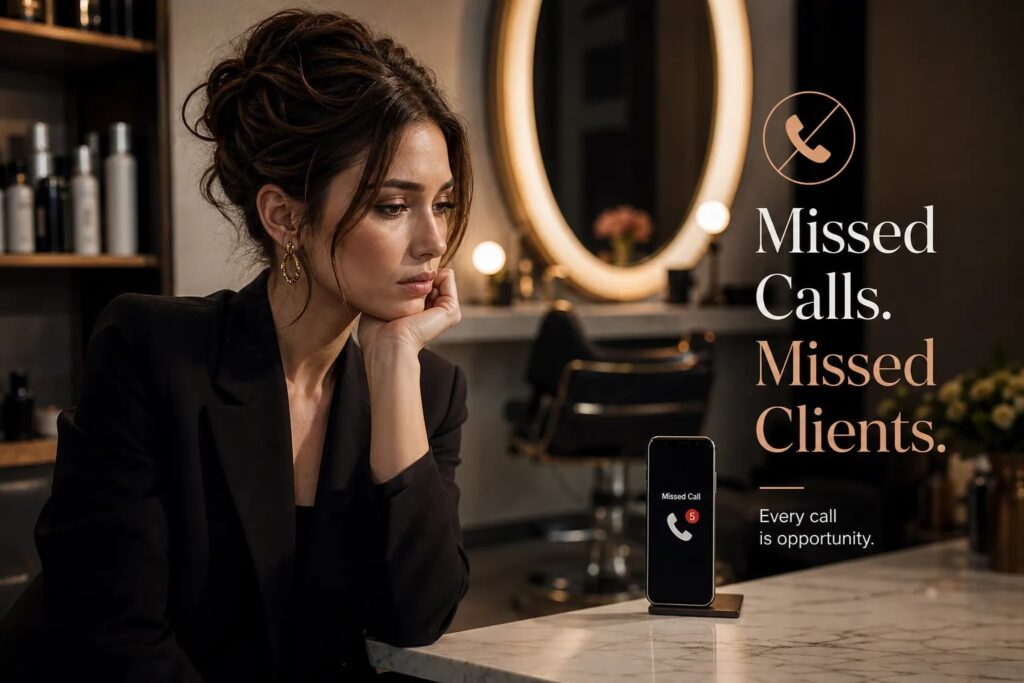
An AI voice agent for salons is a phone system that answers every inbound call 24/7, understands natural language requests like “I need a balayage with Mia on Saturday,” and books the appointment directly into your salon software without a human picking up. It captures bookings during styling hours, after closing, and on weekends when your front desk physically cannot answer. Industry data consistently shows that every unanswered call carries a measurable revenue cost, and that cost compounds quickly. Salon-specific systems like Fully Booked AI® have built this technology specifically for hair salons, with Phorest and Meevo integration designed for salon scheduling logic, so there is no generic setup or middleware guesswork required.
This article breaks down what the technology actually does, what it costs your salon to go without it, what features matter most, and how to evaluate integration claims before you spend a dollar.
Key takeaways
- Real revenue at risk: Count the calls your salon misses in a week, multiply by your own average ticket, and you have the number that matters. Most owners have never run it.
- After-hours demand is real: Clients book around their own working day, which often means evenings and weekends when your front desk is closed.
- Native integration is non-negotiable: A voice agent that connects through middleware workarounds may miss service duration rules, stylist assignments, and deposit requirements, creating double-bookings and scheduling errors.
- Fewer no-shows: Automated text confirmations and real-time rescheduling during the call help protect bookings you already have. Measure your own rate before and after. Automated text confirmations and real-time rescheduling during the call help protect bookings you already have.
- Add-on services: A properly configured agent can prompt add-on services after a booking is confirmed, which lifts the value of calls you were already going to take.
What an AI voice agent actually does on a salon call
A caller dials at 7 p.m. on a Sunday and asks for a keratin treatment with a specific stylist next Friday afternoon. The salon AI receptionist checks live availability, confirms the service duration, accounts for the stylist’s schedule, and books the appointment directly into the salon’s scheduling system. No voicemail. No callback queue. The caller hangs up with a confirmed booking and an SMS confirmation already on its way.
This is meaningfully different from a basic answering service or IVR menu. The agent understands natural speech, handles service names, stylist preferences, and appointment changes conversationally. It does not ask the caller to press one for haircuts or two for color services. It listens, interprets, and responds the way a trained front desk team member would.
It is also different from a website chat widget. An AI voice agent for salons handles phone calls in real time, completing the transaction while the client is on the line. A chat widget handles text-based interactions on your website. Salon owners frequently conflate the two, and that distinction matters when you are evaluating what your salon actually needs to stop losing phone-based bookings.
How much revenue does your salon lose to missed calls?
The math is straightforward once you run it. Use your own average ticket, not an industry average. A busy single-location salon misses an estimated 10–20 calls per week, combining peak-hour overflow and after-hours demand. Run that against your own average ticket and your own call log. The result is the only version of this number that means anything for your salon.
Why voicemail doesn’t save the booking
The situation compounds because most callers who reach voicemail do not leave a message. They call the next salon on the list instead of waiting for a callback.
Documented salon outcomes from AI voice systems back this up with specifics. Pull your phone log for the last month and mark every unanswered call by time of day. Evening calls are usually the biggest block, and they are the ones a front desk can never cover.
When does a hair salon need a voice agent the most?
Bookings disappear at the highest rate during three predictable windows. Understanding them helps you quantify what an AI voice agent for salons is actually worth to your specific business.
After hours
After hours is the biggest single gap. Many salons close between 7–9 p.m., and high-intent clients, working professionals and weekend planners especially, often call in the evening after their own workday ends. Without an AI phone receptionist, those calls go to voicemail or ring out completely. Clients often reach out outside normal business hours, when no one is there to answer.
Weekends
Weekends present a different problem. Demand spikes on Saturdays when front desk staffing is often lighter than on a busy Thursday. The result is a collision between maximum call volume and minimum capacity to answer, exactly the condition that sends the most bookings to voicemail or to a competitor who picks up on the second ring.
Peak styling hours
Peak styling hours, roughly 10 a.m. to 2 p.m. on weekdays, create a third gap. The front desk is fielding walk-ins, managing check-outs, handling internal questions, and running the floor while the phone rings in the background. Calls get missed, rushed, or handled without the attention needed to upsell. Rushed calls do not convert add-on services. A configured AI booking agent for salons handles the overflow while the team focuses on the clients in the chairs.
High-ticket clients booking color corrections, full balayage sets, or keratin treatments tend, in salon owners’ experience, to prefer calling over online self-booking. They want to ask questions, confirm stylist experience, and talk through timing before committing to a three-hour appointment. These are exactly the bookings a salon cannot afford to lose to voicemail.
What your salon’s AI voice agent should be able to do
Not all voice agents are built for salon environments, and generic call center capabilities do not translate cleanly to the scheduling complexity of a hair salon. These are the features that determine whether the system actually works for your business.
Core booking requirements
Live appointment booking is the baseline. The agent must check real-time availability for the specific stylist and service requested, not collect a callback number. If it cannot write the appointment directly into your scheduling software during the call, it is an expensive voicemail system with a friendlier voice.
Cancellations and rescheduling must be completed during the call. Creating a callback request for a reschedule defeats the purpose of the system. The agent should apply your cancellation policy, update the calendar in real time, and send the client a confirmation before the call ends.
Multi-staff routing matters in any salon with more than two stylists. The agent should be able to offer alternatives when a preferred stylist is unavailable, route color corrections to senior stylists automatically, and manage waitlists where relevant. This mirrors how a well-trained front desk team member thinks through a booking request.
Features that separate good from great
Beyond those non-negotiables, the features that separate a good virtual receptionist for salon use from a great one include:
- Upsell prompts that recommend a toner, gloss, or brow service after a booking is confirmed.
- Human escalation with context so that VIP clients, complaints, or complex consultations transfer to a live team member with the full conversation already attached, not starting the call from zero.
- SMS confirmations and reminderssent automatically after every booking.
Why an AI voice agent for salons wins on integration
Salon scheduling software like Phorest and Meevo operates with complex logic: services tied to specific providers, buffer times between appointments, chair assignments, and deposit enforcement. Whether your AI voice agent connects to that logic correctly is the question that determines whether it solves your problem or creates new ones.
How an AI voice agent for salons integrates with Phorest and Meevo
A voice agent that connects through Zapier, Make, or another middleware layer may miss service duration rules, provider assignments, or deposit requirements. The practical risk is double-bookings, incorrect service lengths, or appointments landing on the wrong stylist’s calendar. Native integration means the agent reads live availability from the salon software itself and writes the appointment back into that system the same way a front desk team member would. Always request a live integration demo and verify against your platform’s partner documentation before committing to any provider.
Here is how the major platforms compare on the integration question:
| Booking platform | Best-documented native AI integration | How booking sync works |
|---|---|---|
| Phorest | Direct API integration (Fully Booked AI® and select specialist vendors) | Agent reads live diary via Phorest API, writes confirmed appointments directly; Phorest remains source of truth. Verify via Phorest partner documentation. |
| Meevo | Direct API integration (Fully Booked AI® and select specialist vendors) | Same real-time read/write model; service rules, staff assignments, and buffer times are honored. Verify via Meevo partner documentation. |
| Fresha | Fresha AI Concierge, AgentZap | Native connectors write directly to Fresha calendar; third-party agents use a live API connector |
| Vagaro | AgentZap, some webhook-based connectors | Near-real-time updates via Vagaro webhooks; staff-level availability is supported with verified connectors |
| Mindbody | Qlient.ai, BookingBee | Partner-gated API access; reads real service and provider availability, writes bookings through approved integration |
| Square Appointments | BookingBee, AgentZap, JustCall workflow | Connectors create and update appointments in Square directly; calendar-only setups miss staff and deposit rules |
For salon owners on Phorest or Meevo, Fully Booked AI® includes direct platform integration as a core feature of its done-for-you system, not an add-on or workaround. The voice agent is configured for your service menu, provider availability, booking rules, and deposit requirements from the start. That is the distinction between an automated salon phone system built specifically for the industry and a general-purpose AI tool you are expected to configure yourself. Confirm specifics, including integration scope and onboarding steps, directly with the Fully Booked AI® team during your discovery call.
The simplest way to stop losing bookings to a ringing phone
Return to the math: take your unanswered calls for one month, estimate how many of those callers would have booked, and multiply by your own average ticket. That number grows when you factor in high-ticket callers booking balayage sets and color corrections, after-hours demand from premium clients, and the compounding effect of clients who reach voicemail, get no callback, and never rebook.
An AI voice agent for salons closes that gap by answering every call, completing every willing booking, and handling cancellations and rescheduling without adding a single staff hour. The features matter. The integration matters more. A system that does not connect natively to your booking software will create scheduling errors that cost you more than the missed calls did.
For salon owners already on Phorest or Meevo, Fully Booked AI®’s done-for-you system is designed to handle configuration and integration on your behalf, so the voice agent can be live and answering calls without a lengthy technical setup on the owner’s end. To understand exactly where your salon’s current gaps are and how much they are costing you each month, reach out to the Fully Booked AI® team to walk through a revenue diagnostic built specifically for your business.
Missed calls are one of six revenue leaks we map in every salon. To have yours counted against your real call volume and ticket data, request a revenue leak audit.
Frequently Asked Questions
How can I verify a vendor’s performance and the numbers they quote?
I recommend requesting raw call logs and before-and-after comparisons to verify vendor claims. Also ask for a live integration demo and check the provider’s partner documentation so you can confirm the system reads and writes appointments the same way your scheduling software does.
What do these AI voice systems actually cost and what ROI should I expect?
Costs vary by provider. Ask for a total cost-of-ownership figure covering phone minutes, integration, texting and setup, then set it against your own missed-call math.
How do AI voice agents reduce no-shows?
Automated SMS confirmations and real-time rescheduling during the call drive the reported no-show reductions. Track your own no-show rate before and after launch so you see the real change. due to those confirmations and immediate updates.
Will an AI voice agent create double-bookings or scheduling errors?
If the agent connects through middleware like Zapier or webhooks it can miss service duration rules, provider assignments, and deposit requirements, which risks double-bookings and incorrect appointments. Native, direct API integration that reads live diary data and writes confirmed appointments back into Phorest or Meevo prevents those errors, so verify integration depth during your evaluation.
What should I ask during a discovery call with Fully Booked AI®?
Ask them to confirm the integration scope, onboarding steps, and that direct platform integration is included as a core feature rather than an add-on. Request a live integration demo, inquire about how they configure your service menu and deposit rules, and ask for a revenue diagnostic built specifically for your business.
Michele Matkovich is the founder of Fully Booked AI® and the author of The Luxury Contradiction. She ran her own luxury salon for years, scaled it to $1.4M, and now builds and runs the revenue systems her clients keep. Named Best AI-Powered Salon Marketing Agency in NC in 2025 and an Authority Magazine Female Disruptor.