
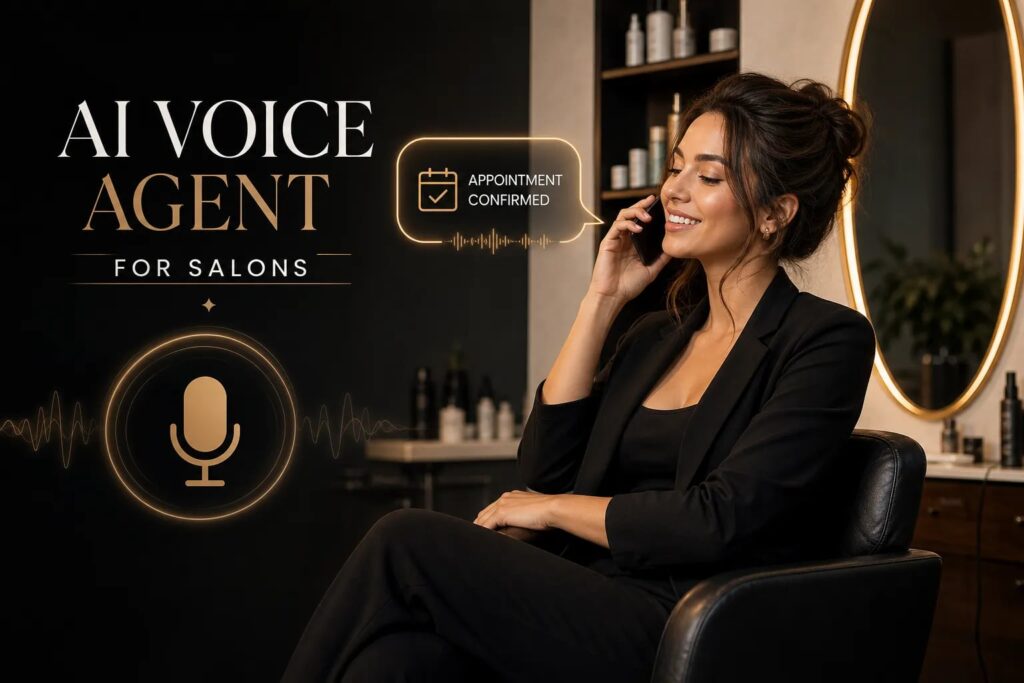
What is an AI voice agent for a salon? It’s a software-powered virtual receptionist that answers your salon’s phone calls, books appointments, handles rescheduling and cancellations, and responds to common client questions around the clock, without a human picking up. It connects to your booking software and speaks to callers in a natural, conversational way, much like a front desk team member would. Unlike a phone tree or voicemail, it understands caller intent and responds in real time, handling the full conversation from greeting to confirmed booking. Integration methods vary, native API, middleware, or calendar sync, so “connects directly” means different things depending on the vendor you choose.
Every salon has calls it can’t answer, calls lost to voicemail while staff are elbow-deep in a color treatment, on their lunch break, or simply off the clock. Those aren’t just missed calls. They’re missed bookings from clients who simply call the next salon on the list. The 24/7 AI voice agent built into Fully Booked AI® is designed to close that gap, capturing high-ticket bookings at 9 p.m. that a front desk physically cannot answer.
This guide covers what these systems actually do, what results you can realistically expect, what they cost, and how to get one running without disrupting your floor.
Key takeaways
- Always-on answering: A salon AI voice agent handles inbound calls 24/7, including after hours, weekends, and during services when staff can’t pick up.
- Real booking, not just messages: A properly integrated agent writes confirmed appointments into your booking system during the call, not after a staff follow-up.
- Know the real cost: Get a total cost-of-ownership quote, not just the base subscription, because integrations and texting are often extra.
- Integration level matters: Native API access to Phorest or Meevo books appointments in real time; Zapier-based middleware and calendar sync cannot reliably do the same.
- Run your own math: Count your unanswered calls, multiply by your own average ticket, and set that against the monthly fee. Use your numbers, not a vendor’s.
- Pilot first: Starting with after-hours or overflow calls before a full rollout reduces risk and builds confidence in the agent’s accuracy.
What is an AI voice agent for a salon, and what does it actually do?
A salon AI voice agent is not a phone tree and not a voicemail system. It listens, understands what the caller wants, and responds in real time with a natural-sounding voice. The core task list covers the full front desk experience:
- Inbound call answering
- Appointment booking
- Reschedule and cancellation management
- Waitlist filling
- FAQ responses covering hours, prices, services, and policies
- New-client data capture
- Post-appointment reactivation outreach
The agent handles routine work well. For complex situations, complaints, or anything sensitive, it routes the call to a staff member rather than attempting to manage it alone. Getting that handoff rule right during setup is critical, a well-configured agent knows its limits.
How the agent handles bookings and changes
When a caller wants to book, the agent asks for the service, preferred stylist, and date. It checks live calendar availability, confirms the open slot, and writes the appointment directly into the booking system before the call ends. Reschedule and cancellation flows work the same way: the agent finds the existing appointment, proposes or accepts a new time, updates the record, and sends a confirmation.
The critical distinction is that a properly integrated agent books the appointment in real time, not just takes a message for staff to follow up on. That difference matters most during after-hours calls, when no one is in the salon to act on a message before the client calls a competitor.
What it does beyond the call
The agent doesn’t stop working when the call ends. It sends SMS reminders and booking confirmations automatically. When a cancellation comes in, it contacts waitlisted clients immediately rather than leaving the slot empty until morning.
Every answered call also becomes a data-gathering event. New-client names, contact details, and service preferences are written into your CRM automatically, building a cleaner contact database without any manual effort from your team.
What results should you expect?
Your results depend on your own call volume and your own average ticket. Here is the math to run before you buy anything: unanswered calls per month, times the share of those callers who would have booked, times your average ticket. Your phone log gives you the first number. Your booking software gives you the third. The middle one is a guess, so pick a cautious number and treat it as a guess.
Fewer no-shows
Automated reminders help protect the revenue you already booked. Pull your no-show rate for the last few months before you launch, then compare it after. That comparison is the only no-show number that matters for your salon.
What does a virtual salon receptionist cost?
Pricing varies a lot by vendor and by how much of the front desk the agent covers. Basic call answering and FAQ responses usually cost less. Live booking integration, text confirmations, multi-stylist scheduling, and waitlist automation usually cost more.
The three main pricing models explained
Vendors price these services three ways, and each suits a different call volume and budget style.
| Pricing model | How it works | Best for |
|---|---|---|
| Flat monthly subscription | Fixed fee includes a set call or minute allowance | Salons that want predictable expenses |
| Usage-based pricing | Charged per minute or per call | Lower-volume or seasonal salons |
| Hybrid plan | Monthly base fee plus overage charges above the included limit | Growing salons with variable call volume |
What to check beyond the headline price
Advertised prices often leave out phone minutes, booking integration fees, text confirmation costs, setup charges, and multi-location support. Ask for a total cost-of-ownership figure in writing, not just the base subscription rate.
Which booking platforms does it work with, and why does integration type matter?
Not all integrations work the same way, and vendors often market three very different technical setups using identical language. Understanding the difference before you sign a contract will save you from a system that takes messages instead of actually booking appointments.
Native API vs. middleware vs. calendar sync
Native API integration is the gold standard. The agent reads live availability and writes confirmed appointments directly into the booking platform during the call. The caller hangs up with a real booking in the system, not a request sitting in a message queue waiting for a staff member to act on it.
Middleware connections, often built through automation tools, capture the caller’s intent and pass it through an additional layer before reaching the booking system. This works for simple scenarios but introduces failure points, delays, and accuracy problems when handling simultaneous calls, reschedules, deposits, or complex provider availability rules. Calendar sync is weaker still: the agent can read slots but typically cannot write true bookings into the management system, despite being marketed in similar terms.
Before signing with any vendor, ask them to run a live demo that books a specific stylist at a specific time, processes a reschedule, applies your deposit policy, and writes the confirmed appointment into your actual system in real time. That test separates genuine booking integration from sophisticated message-taking.
How an AI voice agent for salons integrates with Phorest and Meevo
Phorest and Meevo are among the most widely used management platforms among established independent salons, and many AI voice agent vendors don’t offer true native API access to either one. A properly integrated system matches services to correct durations and providers, applies cancellation and deposit policies, fills waitlists automatically, and syncs confirmation messaging without any staff involvement.
Fully Booked AI® built its integration with Phorest and Meevo with salon-specific workflows in mind, so owners aren’t left troubleshooting a middleware failure or untangling a sync error that double-booked a colorist. That distinction becomes clear when you compare it against vendors using an automation bridge or a calendar overlay and calling it a full integration.
How long does setup take, and how do you start without risking your floor?
Setup time depends on your booking platform and how much you want the agent to do. A basic FAQ-and-booking setup is the quickest. Adding CRM sync, text confirmations, deposit collection, and multi-stylist scheduling takes longer, and multi-location builds take the longest. The biggest factor is how organized your source material is when onboarding begins.
What you need to prepare before launch
The speed and accuracy of your setup depends heavily on the information you bring to the onboarding process. Come prepared with the following:
- Complete service menu including durations and prices
- Stylist specialties and availability rules
- Business hours and location details
- Cancellation and deposit policies
- Your most common client FAQs
Organized, accurate source material cuts setup time significantly and directly affects how the agent handles real calls from day one.
The smart way to pilot before going all-in
Start with after-hours calls or overflow traffic only. Review call transcripts and missed booking data every day during the first two weeks. Expand to all inbound calls once the agent’s accuracy is confirmed across your actual service menu and policies.
The metrics that matter during a pilot are:
- Answered-call rate
- Calls converted to appointments
- After-hours bookings captured
- No-show rate
- Cancellations filled from the waitlist
- Incremental revenue minus the agent fee
Fully Booked AI® clients go through this pilot process fully managed, the owner reviews results rather than configuring software or troubleshooting call flows.
A quick note on privacy and compliance
Standard appointment booking data, service type, date, stylist preference, falls outside HIPAA’s scope for most salons. If your salon collects any protected health information (common in medical spas or wellness services), a Business Associate Agreement is required with your vendor before processing that data through a voice agent. Beyond HIPAA, check your state’s call-recording consent laws, confirm that call data is encrypted in transit and at rest, and make sure your vendor has a defined data retention and deletion policy. Disclosing to callers that they’re speaking with an AI is both good practice and increasingly a legal requirement in several states.
Is an AI voice agent the right move for your salon right now?
An AI voice agent for a salon pays for itself quickly when two conditions are true: the salon is losing calls it cannot answer, and those calls represent real booking demand. If your front desk is already capturing every call and your calendar is consistently full, the ROI case is thinner. For established single-location salons where missed calls during services, lunch, and evenings are a daily reality, this is a measurable and fixable revenue leak, and the math on fixing it is usually straightforward.
The practical next step is to run your own numbers before buying anything. Count how many calls go unanswered in a typical week, estimate how many of those callers would have booked, and multiply by your average ticket value. Set that monthly figure against the quote you get from any vendor. Build the model with your own call volume and ticket data.
If you want that calculation done for you, alongside a full audit of where your salon is losing revenue, request a revenue leak audit from Fully Booked AI®. We map your salon against the six revenue leaks and run the numbers on your actual call volume and ticket data.
Frequently asked questions about AI voice agents for salons
What is the difference between an AI voice agent and a chatbot for a salon?
A chatbot handles text-based conversations, typically on your website or via SMS. An AI voice agent handles live phone calls, speaking with callers in real time using a natural-sounding voice. Both can book appointments, but a voice agent specifically addresses the missed-call problem that costs salons the most revenue.
Can an AI voice agent for a salon handle multiple calls at the same time?
Yes. Unlike a single front desk employee, a voice agent can handle simultaneous inbound calls without putting anyone on hold. This is particularly valuable during peak hours when several clients may call within minutes of each other.
Will clients know they’re talking to an AI?
Modern voice agents sound natural, but callers often recognize they’re speaking with an automated system, especially on longer or more complex calls. Disclosing AI use is good practice and is becoming a legal requirement in several states. A well-configured agent focuses on speed, accuracy, and a smooth handoff to staff when needed, rather than trying to pass as human.
What happens if the AI voice agent makes a booking mistake?
A properly integrated agent writes directly into your booking system, so errors show up in real time rather than hours later. Review call transcripts daily during your pilot period to catch any pattern errors quickly. Most vendors provide a correction and re-training process when the agent mishandles a call type.
How does a salon AI voice agent handle cancellations and no-shows?
The agent processes cancellations during the call, updates the booking system, and immediately contacts the next client on the waitlist. Automated text reminders sent in advance help reduce no-shows. Track your own no-show rate before and after so you see the real change in your salon.
Michele Matkovich is the founder of Fully Booked AI® and the author of The Luxury Contradiction. She ran her own luxury salon for years, scaled it to $1.4M, and now builds and runs the revenue systems her clients keep. Named Best AI-Powered Salon Marketing Agency in NC in 2025 and an Authority Magazine Female Disruptor.