
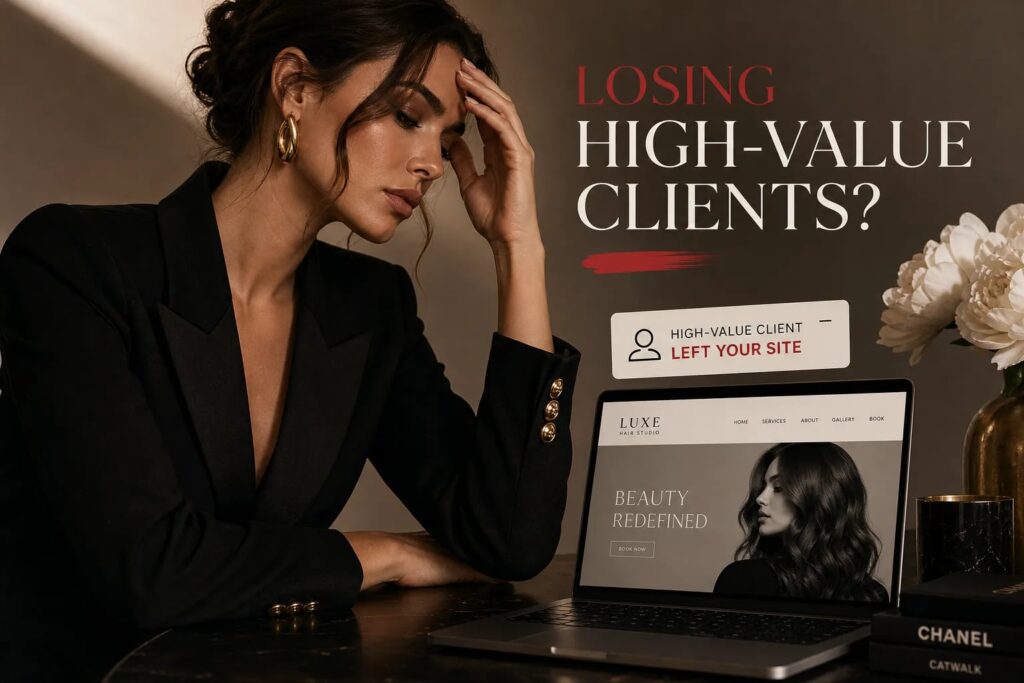
Why your salon website is losing you high-ticket clients comes down to one core problem: your site is filtering out the exact visitors willing to pay premium prices. Clients ready to invest in a color service, extensions, or a full transformation are landing on your site, making a judgment in seconds, and leaving before they tap “Book.” The problem isn’t your pricing, your services, or your market. It’s five diagnosable gaps on your website that signal “average” to exactly the clients you’re trying to attract. A luxury salon website has to signal premium before a visitor ever reaches the booking page.
Luxury clients make booking decisions based on digital first impressions. A positioning mismatch between your in-chair experience and your online presence doesn’t just cost you a single booking, it redirects your ideal clients to competitors whose websites better reflect what they charge. This article walks through the specific salon website mistakes driving that pattern and the exact fixes that close the gap. Fully Booked AI® uses a proprietary Five Invisible Leaks diagnostic framework to identify where your salon’s revenue is escaping.
Key takeaways
- Above-the-fold messaging: A generic headline disqualifies premium clients within a few seconds. Specificity about service, outcome, and client identity is the fix.
- Social proof placement: Testimonials placed beside service descriptions convert better than testimonials buried on a separate reviews page.
- Portfolio quality: Stock photography signals that your real work isn’t worth showing. Editorial-quality images of actual client results are non-negotiable.
- Booking flow friction: Industry benchmarks put beauty booking abandonment at 37%. Every extra step costs you high-ticket appointments you already paid to attract.
- Brand-positioning gap: A premium-priced service presented on a low-quality site often feels mismatched to prospective clients, and that mismatch costs bookings.
Is your above-the-fold messaging signaling luxury or losing it?
The headline test every premium client runs in seconds
High-ticket clients scan your hero section for one thing: a signal that this salon serves someone like them. They’re not reading; they’re pattern-matching. A headline like “Welcome to [Salon Name]” or a generic opener like “Book Your Next Appointment” gives them nothing to match against, so they leave.
Luxury positioning statements work because they combine a specific outcome, a client identity, and a brand voice in a single line. The difference between “Book Now” and “Precision Color and Extension Work for Women Who Don’t Compromise on Their Hair” is the difference between a site that blends in and one that makes the right client stop scrolling. Keep the headline under roughly twelve words, then let the subheadline explain the experience or method in one sentence. This is a core salon website conversion tip that costs nothing to implement and pays off immediately.
Why your salon website is losing you high-ticket clients above the fold
Your hero section must contain a visible, high-contrast booking CTA. That’s table stakes. But the CTA also needs to repeat: after service descriptions, after testimonials, and after stylist bios, because those are the points where a visitor’s conviction peaks.
The mobile implication is significant. If your booking button isn’t visible without scrolling on a phone, consistent with standard mobile UX best practices of keeping primary actions immediately accessible, most visitors won’t look for it, and most won’t bother. Well-structured premium service pages tend to outperform those with buried CTAs on conversion rate. Above-the-fold CTA placement is one of the primary levers that gets them there.
Why your social proof hierarchy is filtering out premium clients
Generic five-star ratings vs. the testimonials that actually convert
A 4.9-star rating tells a high-ticket client that people like the salon. It doesn’t tell her that someone with her hair type got the balayage result she’s looking for. Generic reviews, “Love this place! 5 stars!”, give no information about the service, the stylist, or the outcome, so they carry almost no persuasive weight for premium buyers.
The fix is strategic placement, not just better copy. Feature two or three detailed testimonials that name the service, the client’s first name, and the outcome, positioned directly beside the corresponding service description. A live Google review feed adds something handpicked quotes can’t: recency and review volume, which make the overall rating feel credible rather than curated. These are the trust signals for beauty businesses that actually move high-ticket buyers.
How to sequence trust signals for high-ticket conviction
Trust signals placed in the wrong order reduce their own impact. Stylist credentials listed before the visitor understands your service offering register as noise. The sequence that converts is: verified review summary near the top, specific testimonials beside service descriptions, stylist credentials and certifications after that, then press mentions and awards.
Credential signals that carry real weight include polished stylist headshots, years of experience, recognizable brand partnerships, and relevant certifications. Include only what is genuine and meaningful to the client. A hygiene commitment or premium product partnership can function as a table-stakes trust signal for high-end clients, but only when it appears at the right point in the page flow.
What your portfolio is actually communicating to high-ticket visitors
The visual quality gap between your salon and your website
Stock photography is an immediate disqualifier for luxury clients. It communicates that your actual work isn’t compelling enough to show. Inconsistent lighting, phone-quality screenshots, and generic beauty imagery carry the same signal: this salon doesn’t invest in its presentation.
Editorial-quality photography of your real salon, your actual team, and genuine client transformations is the highest-leverage visual investment a premium salon can make. A strong before-and-after portfolio for salons builds the kind of credibility that generic stock images never can. Stylist-specific portfolios matter here too. Luxury clients often book an individual expert, not a general salon. If a visitor can’t see work by the specific stylist she’d be assigned to, she feels uncertain, and uncertain clients don’t book high-ticket services.
Gallery formats that generate bookings vs. ones that just look nice
The format hierarchy for high-converting portfolios runs as follows: short transformation videos for discovery and initial conversion, carousels of five to seven slides for prospects actively evaluating, and polished single before-and-after images for fast portfolio browsing. A practical starting content mix is 40% transformation videos, 30% educational or transformation carousels, 20% polished single results, and 10% testimonials and behind-the-scenes content.
For each signature service, the portfolio should answer four questions: What does the result look like? How was it achieved? What does a session cost and how long does it take? What do clients say about it? Showing multiple clients who received the same technique is more persuasive than one spectacular outlier, because it demonstrates consistent skill across different hair types rather than a lucky result.
Booking flow fixes that stop your salon website from losing you high-ticket clients
The mobile UX issues that kill conversions before checkout
The majority of salon website visits happen on mobile, and flows that require zooming, scrolling through long menus, or forced account creation before checkout are major drop-off triggers. Industry benchmarks put beauty booking abandonment at 37%, and every additional required form field reduces completion, a consistent finding across salon booking UX research. For a high-ticket service, that math adds up fast.
The optimal mobile booking flow follows this sequence:
- Service selection
- Stylist (optional)
- Live availability
- Contact autofill
- Deposit or payment
- Instant confirmation with an add-to-calendar link
Keep the flow to four steps or fewer. The features that matter most for mobile conversion are real-time availability with no approval delay, guest checkout, Apple Pay or Google Pay support, and autofill for returning clients. Deposits reduce no-shows, but they belong after the core flow is optimized, not as a primary conversion lever.
Presenting premium pricing without triggering sticker shock
Hidden pricing is a trust-killer for luxury clients. If they can’t find what a service costs, they assume it’s either too expensive or inconsistently priced, and they leave. The fix is framing, not just transparency. Lead with what the client receives before you present the number.
A three-tier structure works well for premium service menus. Use “starting at” for services affected by hair density or complexity, but explain the variables and confirm the final price during consultation, before service begins.
The brand-positioning gap and how Fully Booked AI® closes it
When your in-chair experience outperforms your digital presence
This is the core diagnostic finding we see across salon websites nationwide: the physical experience is genuinely premium, but the website communicates none of it. The result is a positioning mismatch. A premium-priced service presented through a site with outdated design, generic copy, and no clear luxury differentiation often feels like a mismatch to the visitor who hasn’t walked through your door yet.
High-ticket clients aren’t comparing prices alone. They’re asking whether the digital experience matches what they’ll be paying for in person. When it doesn’t, they move on, usually to a competitor whose site better reflects the caliber of the work. That’s not a pricing problem. It’s a website problem, and it’s exactly why your salon website is losing you high-ticket clients.
What a rebuilt salon website as a revenue system looks like
This is the specific gap Fully Booked AI® was built to close. We’re a done-for-you agency that specializes in rebuilding salon websites as high-converting authority hubs designed to match the premium positioning of the physical experience. The rebuild covers brand messaging and copywriting aligned to luxury positioning, a social proof hierarchy structured for high-ticket conviction, portfolio systems built around real work, and a salon booking UX optimized for mobile with real-time availability.
One key integration advantage: we connect natively with Phorest and Meevo, so the booking flow on your website pulls live availability directly from your existing salon software. Native integrations reduce sync delays and lower the risk of double-bookings or missed availability. The website is also not a standalone fix. It’s the front end of a broader revenue infrastructure that includes AI search optimization, reputation management, reactivation automation, and a 24/7 AI voice agent for missed calls. Every system in our stack was built and tested on a real salon before we deployed it for anyone else.
Your website audit starts here
Run your site against five diagnostic areas: above-the-fold messaging, social proof hierarchy, portfolio quality and format, booking flow friction, and the brand-positioning gap between your physical and digital presence. Each one is either working for you or working against you.
This isn’t a cosmetic redesign project. It’s a revenue systems decision. Your website filters every potential high-ticket client before they ever call, and the quality of that filter determines how many of them convert. A site that doesn’t reflect the caliber of your work is actively sending premium clients to competitors who do.
If you’d rather not manage this yourself, our team at Fully Booked AI® handles the full rebuild and ongoing management from end to end. Fully Booked AI®’s Five Invisible Leaks diagnostic framework pinpoints where revenue is leaking from your site.
Related reading: salon online booking fixes · Google Local 3-Pack for hair salons · ChatGPT SEO for salons
Frequently Asked Questions
Will hiding service prices help attract high-ticket clients?
No, hiding pricing usually drives luxury clients away. We state that hidden pricing is a trust-killer because clients assume prices are either too high or inconsistent; instead, lead with what the client receives and use a three-tier structure with “starting at” where needed while explaining variables and confirming the final price during consultation.
Should we require deposits during the booking flow to secure high-ticket appointments?
Deposits can reduce no-shows, but they should come after the core booking flow is optimized. We recommend optimizing the mobile flow first and then placing deposit collection after real-time availability, guest checkout, and payment options are working smoothly.
How should stylist-specific portfolios be structured to convert premium clients?
Stylist-specific portfolios should show editorial-quality images and multiple examples of the same technique across hair types rather than a single outlier. We recommend a content mix (40% short transformation videos, 30% carousels of five to seven slides, 20% polished single results, 10% testimonials/behind-the-scenes) and ensure each signature service answers what the result looks like, how it was achieved, cost and time, and client feedback.
Will integrating our booking with salon software reduce booking errors and sync delays?
Yes, native integrations reduce sync delays and lower the risk of double-bookings or missed availability. We connect natively with Phorest and Meevo so the website pulls live availability directly from your existing salon software, reducing approval delays and keeping real-time availability accurate.